Alcohol Raises Risk of These 20 Conditions — Including Some That Surprise People


Alcohol linked to more than 200 health conditions. That figure, published by the National Institute on Alcohol Abuse and Alcoholism (NIAAA), barely registers compared to the headline most people still hold in their heads: that a glass of red wine a day is good for the heart. The gap between those two facts is enormous, and it has been quietly closing for years.
A major new analysis accelerated that shift considerably. Researchers conducted 16 systematic reviews across four databases, analyzing 843 cohort and case-control studies using a rigorous framework called the Burden of Proof approach. Published in June 2026 in Nature Health, the goal was not to confirm prior assumptions about alcohol, but to re-examine dose-response relationships as conservatively as possible. High alcohol consumption was associated with increased risk across all 20 health outcomes examined. Several of those outcomes showed elevated risk even at low drinking levels, including amounts below one standard drink per day.
The alcohol health risks most people know about – liver disease, maybe some cancer – represent only a fraction of the picture. The list extends into the cardiovascular system, the lungs, the pancreas, the immune system, and the brain. Here is what the current evidence says about each one.
Cancers: The Strongest and Most Extensive Evidence
Alcohol consumption is associated with increased risks for cancers of the breast, colorectum, esophagus, larynx, lip and oral cavities, pharynx, liver, stomach, pancreas, and prostate – ten cancer types in total. Even consumption below one standard drink per day was associated with elevated risk for cancers of the pharynx, colorectum, esophagus, breast, liver, pancreas, and prostate. People who assumed that keeping drinking “light” protected them from cancer risk will find that assumption overturned.
Pharyngeal cancer – cancer of the throat area connecting the nose and mouth to the esophagus – carries the highest relative risk of any condition in the study, with at least a 105% increase in risk at average consumption levels.
Breast cancer carries its own sobering numbers. According to Johns Hopkins Bloomberg School of Public Health, the risk of cancer increases with the amount of alcohol consumed, and for breast cancer specifically, the risk is elevated at even one drink per day. A 2026 study reported by BreastCancer.org found that women who drink heavily have a 52% higher risk of developing breast cancer than non-drinkers.
Colorectal cancer risk climbs with cumulative intake over a lifetime. A 2026 study found that heavy average lifetime alcohol intake was associated with higher colorectal cancer risk, especially rectal cancer, and that consistent heavy drinking throughout adulthood was positively associated with colorectal cancer risk. Even one alcoholic drink a day is associated with increased risks of esophageal, gastric, and colorectal cancers – meaning for these digestive tract cancers, no amount of drinking appears entirely safe.
The mechanism behind this is increasingly well understood. Alcohol causes DNA damage, inflammation, and oxidative stress, which can trigger cancer growth. It also raises circulating estrogen levels, playing a direct role in hormone-sensitive cancers like breast cancer.
Alcohol consumption is the third leading preventable cause of cancer in the United States, after tobacco and obesity, causing about 100,000 cancer cases and 20,000 deaths from cancer each year. In January 2025, U.S. Surgeon General Dr. Vivek Murthy issued an advisory citing scientific studies linking alcoholic beverages and an increased cancer risk, calling for cancer warning labels on alcoholic beverages and naming at least seven cancer types linked to alcohol.
Liver Disease: Cirrhosis and Chronic Damage
The liver is where alcohol is metabolized, and repeated exposure takes a measurable toll. The 2026 Nature Health analysis found alcohol was associated with a substantially higher risk of cirrhosis and chronic liver diseases, with at least a 40% increase in risk. Cirrhosis is the scarring of liver tissue to the point where the organ can no longer function properly. Once established, it is largely irreversible.
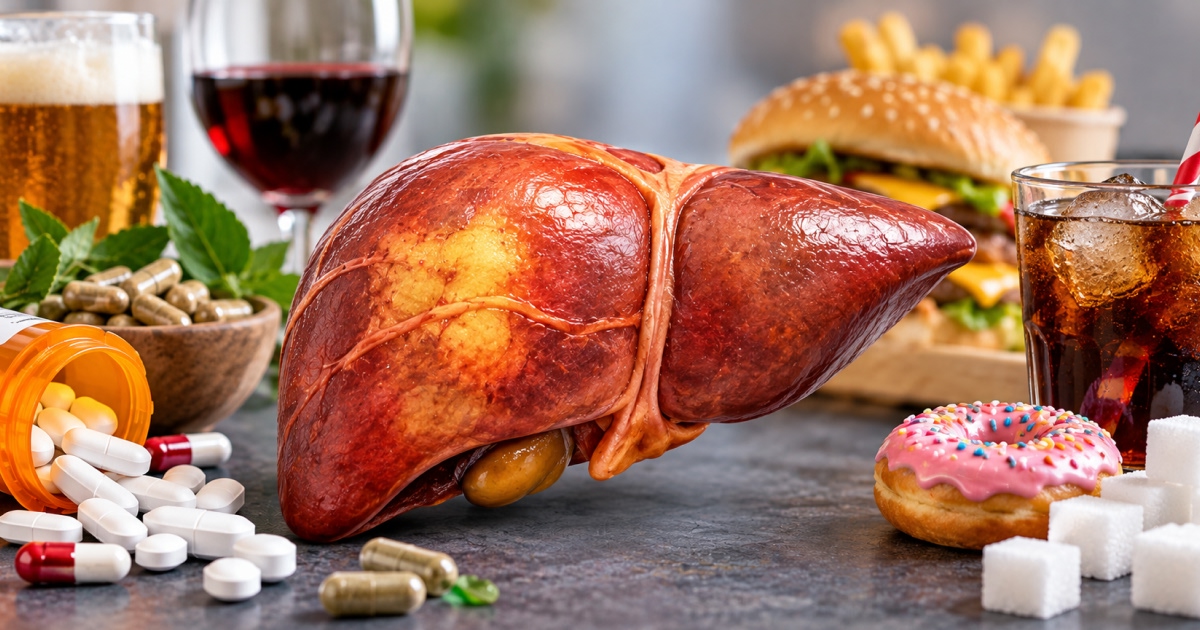
For a practical look at how liver damage plays out clinically, people who want to understand what damages the liver beyond alcohol will find that even everyday dietary choices can compound the risk.
Pancreatitis
The pancreas – a gland behind the stomach that regulates blood sugar and digestion – is highly vulnerable to alcohol. A 2025 study published in the Journal of Internal Medicine found that the 10-year cumulative incidence of hospitalization for acute pancreatitis was 2.7% in people with alcohol-related liver disease, compared to 0.6% in matched population comparators – roughly a six-fold higher rate. The broader evidence base shows heavy alcohol consumption increases pancreatitis risk substantially, with risk compounding significantly alongside existing liver disease.
Pancreatitis causes severe abdominal pain, nausea, and vomiting, and chronic cases can lead to permanent digestive damage and increase the risk of pancreatic cancer.
Heart Rhythm and Cardiovascular Conditions
Atrial fibrillation (AF) – an irregular, often rapid heart rhythm that increases stroke risk – has a well-documented association with alcohol. Meta-analyses have concluded that heavier alcohol consumption predicts a heightened risk of developing atrial fibrillation, and instrumental variable analyses have suggested causal relationships between alcohol exposure and AF in large studies.
Known as “Holiday Heart Syndrome,” atrial fibrillation and other irregular heart rhythms can be triggered by binge drinking even in healthy individuals. The sudden influx of alcohol can overstimulate the heart and disrupt its electrical signals, producing arrhythmias that can last for hours or days.
Stroke is also on the list. Light and moderate alcohol consumption was inversely associated only with ischemic stroke (caused by a clot), whereas heavy drinking was associated with higher hemorrhagic stroke risk (caused by bleeding) – and heavy drinkers had a stroke on average 14 years earlier than non-heavy drinkers.
Lower Respiratory Infections
Alcohol use disorder has been found to be an independent risk factor for acute respiratory distress syndrome (ARDS) – a life-threatening condition where fluid builds up in the lungs – with a two- to four-fold increased risk. The broader connection to lower respiratory infections, including pneumonia, reflects alcohol’s suppression of immune function. A compromised immune response leaves the lungs more vulnerable to bacterial and viral pathogens.
Tuberculosis
TB is not typically framed as an alcohol-related disease, but the data are consistent. Alcohol use was associated with a 35% higher risk of TB compared to no alcohol use. The risk of active tuberculosis becomes substantially greater in people who drink more than 40 grams of alcohol per day – roughly equivalent to three standard drinks. The mechanism likely involves both immune suppression and the social circumstances associated with heavy drinking.
Type 2 Diabetes
Diabetes follows what researchers describe as a U-shaped relationship with alcohol. Light to moderate alcohol consumption was associated with a lower risk of type 2 diabetes among women in a 2025 analysis, with the potential reduction in risk reaching around 30%. Heavy consumption reversed that association, raising diabetes risk rather than lowering it.
The 2026 Nature Health study placed this finding in context: the apparent benefit at low intake levels may reflect observational bias, since former drinkers who quit due to illness often appear as “abstainers” in studies, making light drinkers look healthier by comparison. The authors noted that for conditions like diabetes, the evidence is mixed and should not be taken as a reason to drink.
Dementia and Alzheimer’s Disease
The old “moderate drinking protects the brain” claim has largely collapsed under scrutiny. A 2025 study published in BMJ Evidence-Based Medicine – the largest combined observational and genetic study of its kind – found that any level of alcohol consumption can increase the risk of dementia. Led by researchers at the University of Oxford, Yale University, and the University of Cambridge, the study tracked more than 500,000 adults across two large population databases and found that every additional one to three drinks per week came with a 15% higher dementia risk.
Even light drinking, generally thought to be protective based on observational studies, is unlikely to lower the risk, which rises in tandem with the quantity of alcohol consumed. Earlier studies showing a benefit from moderate alcohol intake appear to have suffered from a methodological flaw: people who quit drinking because they were already becoming cognitively impaired were classified as non-drinkers, inflating apparent risk in the abstainer group. Reducing the prevalence of alcohol use disorder, the research suggests, could prevent up to 16% of dementia cases.
Read More: 4 Surprising Side Effects You May Experience When You Quit Alcohol
Ischemic Heart Disease: Mixed Evidence, Clear Limits
For ischemic heart disease – reduced blood flow to the heart – the evidence is genuinely mixed. Some observational studies show a small reduction in risk at low intake, but those findings conflict with genetic studies designed to reduce bias. The American Heart Association’s 2025 scientific statement, published in the journal Circulation, concluded that no research has proven a cause-and-effect link between drinking alcohol and better heart health. Using modern techniques such as genetic studies and trial emulation, the AHA found no heart benefit from alcohol consumption and identified possible harm. Heavier drinking, the statement noted, “is consistently associated with worse outcomes in every cardiovascular disease entity studied” – including high blood pressure, atrial fibrillation, stroke, heart failure, and sudden death.
The apparent benefit seen in some older observational studies appears to be a product of healthier lifestyles among moderate drinkers, or the misclassification of sick former drinkers as abstainers, rather than a direct protective effect of alcohol.
What to Do With This Information
Across all 20 health outcomes examined in the 2026 Nature Health analysis, high consumption was uniformly harmful, and several conditions showed elevated risk at even low intake levels. The full body of evidence now shows that alcohol health risks begin at low consumption levels for most cancers, and that the conditions associated with drinking span virtually every major organ system.
Cutting back delivers measurable benefits relatively quickly. According to Johns Hopkins Bloomberg School of Public Health researchers, participants in Dry January studies often see lower blood pressure, better energy, stronger concentration, and reduced anxiety within a few weeks of stopping. That improvement doesn’t require permanent abstinence – reducing the frequency and quantity of drinking produces real gains.
If you currently drink, the most evidence-supported action is reducing both how often and how much. The AHA advises that anyone who doesn’t currently drink should not start for any perceived cardiovascular benefit – that claim is not supported by current research. For anyone with a personal or family history of cancer, liver disease, or heart rhythm problems, the case for minimizing alcohol is substantially stronger than it was even five years ago. The science no longer supports the idea that low-to-moderate drinking is neutral or protective across the full range of health outcomes – and that shift, driven by 843 studies and multiple independent research teams, is not a messaging trend. It is the data.
Disclaimer: This information is not intended to be a substitute for professional medical advice, diagnosis, or treatment and is for information only. Always seek the advice of your physician or another qualified health provider with any questions about your medical condition and/or current medication. Do not disregard professional medical advice or delay seeking advice or treatment because of something you have read here.
AI Disclaimer: This article was created with the assistance of AI tools and reviewed by a human editor.
Read More: Not Just Alcohol: Surprising Diet Habits That May Raise Liver Cancer Risk